Margaret

The revolution galloped

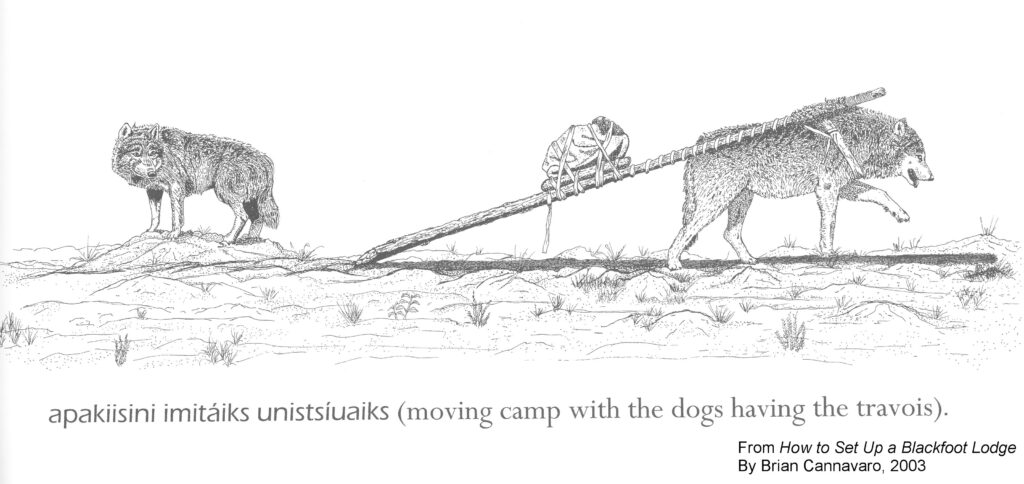
(Above: In the area that would become Montana, Indigenous people used dogs to pull travoises. Horses were a game-changer, and contributed to the rapid rise of horse nations in the West.)

As leaders of the nascent United States signed the Declaration of Independence, in this region 250 years ago — then a claim of Spain — another revolution was afoot, on four feet.

Although present in this area thousands of years ago according to fossil evidence, the horse had disappeared from western North America until Hernan Cortes made landfall much farther south, unloading more than a dozen horses in the Yucatan in 1519 from the holds of his ships.

Indigenous peoples didn’t have to have horse technology explained to them. They ran with it, and the horse population spread like wildfire along the mountainous spine of the American West, so quickly that the area to become Northwest Montana saw horses decades before California.

Some Indigenous people called horses “elk-dogs” on first encounter. Horses were a dream come true: collapsing distances to hunting grounds and enabling easier travel across rugged landscape. They were integral to increasing trade, protection, and conquest. In little more than a lifetime, the Ksanka (Kootenai), Selis (Salish), Qlispe (Pend d’Oreille), and Niitsitapi (Blackfeet) saw horses transform life in the northern Rockies. 

Join us at the Northwest Montana History Museum for 250 Years Ago: This Revolution Came at a Gallop,  a presentation by equine researcher Brenda Wahler, who often writes and lectures on horse history. The museum also presents a companion exhibit, A Western Revolution Came First.

More about the presenter: Helena author and lawyer Brenda Wahler has consulted widely on equine matters and written several books, including Montana Horse Racing and, most recently, Marcus Daly’s Montana Empires, which prominently features Daly’s significant horse-related activities. Copies of books will be available for sale and signing.

Details for both 250-year anniversary events: 

Talk: 250 Years Ago: This Revolution Came at a Gallop, featuring equine historian Brenda Wahler at 6 p.m. Thursday, June 18; doors open 5 p.m.; free admission

Exhibit: A Western Revolution Came First: The Rise of Horse Nations in Northwest Montana
opens in June (on view anytime museum is open) 

Northwest Montana History Museum, 124 2nd Ave. E., Kalispell, MT 59901; 406-756-8381
nwmthistory.org; regular museum hours 10 to 5 Monday-Friday

The revolution galloped Read More »

Up with downtown

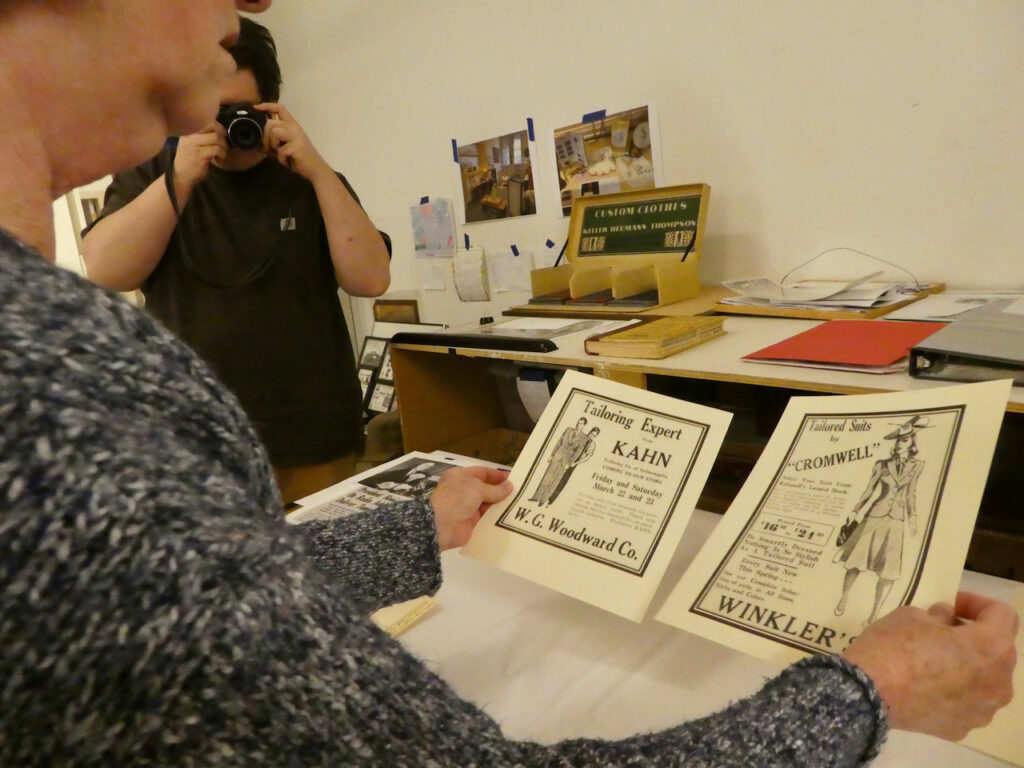
The exhibit, Going to Town: Stroll Kalispell in 1941, remembers the city’s Golden Jubilee, which marked Kalispell’s 50th birthday (1891-1941). The downtown area served as the commercial hub for Northwest Montana, drawing residents from the Flathead Valley and beyond to shop, socialize, and stroll Kalispell’s downtown streets. Shoppers could find everything from essential goods to high-fashion apparel. Nine automobile dealerships offered 14 different makes of cars. Multiple department stores, restaurants, gas stations, grocery stores, beauty and barber shops, and drugstores lined Main Street.

Visitors will see artifacts including a glass-globed “visible” Husky gas pump, a re-creation of the Mae West sandwich served by the Kalispell Cafe, beauty shop equipment, and period fashions. A grouping of items purchased from the Kalispell Sears Roebuck Order-Only Store alongside the original catalogue advertisements occupy a corner of the exhibit. Also on display: a rare 1938 Western Field rifle—one of 189 made by Mossberg and sold under the Montgomery Ward brand.

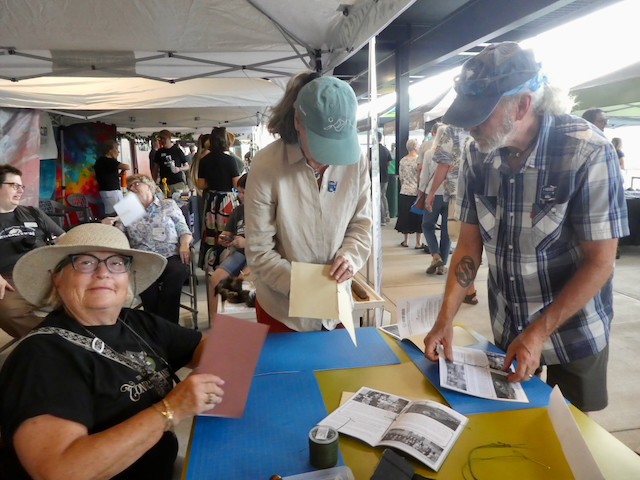
Photos of 1941 storefronts in Kalispell along with vintage ads (as shown by one of the volunteer curators, Nancy Hart, above) offer insight into our area’s economy and consumer trends.

An interactive kids’ area features period automobiles.

Visitors are encouraged to wear 1940s period attire, and car owners of the 1941 vintage or earlier are welcome to park in front of, or streets around, the museum for extra ambiance.

Details:
Going to Town: Stroll Kalispell in 1941
free exhibit-opening reception: 5 to 6:30 p.m. July 1

Northwest Montana History Museum, 124 Second Ave. E., Kalispell, 406-756-8381; nwmthistory.org 
Regular museum hours: 10 a.m. to 5 p.m. weekdays, 10 a.m. to 3 p.m. most Saturdays from June through August

Up with downtown Read More »

Are you getting ready for summer?

We are!

We are busting out of winter with lots of events on the way, at least three new or updated exhibits, and more.

We’re also hoping to hold Saturday hours from 10 a.m. to 3 p.m. June through August. Should you like to help us offer Flathead visitors and residents the opportunity to visit the museum outside of the workweek, we’d love to talk to you! We seek two volunteers, one for the Welcome Desk and another for the bookstore.

One year a couple of friends did it in tandem and enjoyed the chance to both spend time together and to share regional history.

Contact Margaret at the museum if you are interested. We can fill in on certain Saturdays if you can’t commit to all 13.

Thank you for considering this valuable and fun opportunity to serve the museum and the community!

Are you getting ready for summer? Read More »

Wanted: operations manager

Keep the museum going full steam ahead, and help share the stories of Northwest Montana!

The role of Operations Manager is now open:

The approximately 30-hour/week position at Northwest Montana History Museum is key to running a dynamic nonprofit that draws more than 10,000 visitors annually.

Duties mainly involve membership and visitor services, data keeping, deposits, volunteer and event coordination, helping with exhibits and programs, social media and other promotion, and facility management.

Qualifications:
Bachelor’s or higher degree
Competent in office systems and software

Qualities of the ideal candidate include:
Enjoys working with the public and a variety of people
Team player
Reliable
Purpose-guided
Active learner and problem solver

$20/hour. Potential for full time with paid vacation and time off.

Wanted: operations manager Read More »

C’mon over and take a look, then give feedback

Above: A tour group visits the museum’s On a Passing Frontier exhibit, which is set for an update, thanks to a grant awarded earlier this year by the Montana 250 Commission.
On the heels of the Northwest Montana History Museum’s successful, wholesale renovation of its oldest exhibit, Lumberjacks, Tie Hacks & River Pigs, which reopened in late 2024, the institution will undertake an update of another of its seven permanent exhibits, On a Passing Frontier: The Earliest Stories from Northwest Montana

To gather public input on the project, the museum hosts a free open house 2 to 4 p.m. Friday, Feb. 20. All are invited to view the exhibit, talk with volunteers and staff, and submit feedback.

As stated in the museum’s successful application for the grant from the Montana 250 Commission, which detailed plans to renovate the longstanding On a Passing Frontier exhibit:

The purpose of this project is to update the Northwest Montana History Museum’s earliest Northwest Montana history exhibit with recent research and modern design to further enhance visitor experience.

“The topics covered will include Flathead Valley Ecology and Native Land Management, Lithic Tools, Salish and Upper Pend d’Oreille People, Kootenai/Ksanka People, Blackfoot/Niitsitapi, and Modern Indigenous History.


Museum volunteers and staff, including project lead Elle Eberts-Robocker, are excited to get started with not only updates to existing displays in On a Passing Frontier, but additions as well as programming to mark the reopening of the exhibit later this year.

The Northwest Montana History Museum is the premier regional history museum for Northwest Montana, drawing more than 10,000 visitors annually to Kalispell’s culture core. Along with seven permanent exhibits, including On a Passing Frontier, the museum showcases two changing exhibits and hosts approximately 150 events per year.

Northwest Montana History Museum, 124 Second Ave. East, Kalispell; 406-756-8381; nwmthistory.org

C’mon over and take a look, then give feedback Read More »

Mr. White says: Schedule your cabin fever cure now

Here we go!

For 24 years, the Northwest Montana History Museum has organized presentations on the many facets of Montana history and life for its John White Series.
 
The talks also give reason to gather in winter with friends, family, and others who share curiosity for our state and its people. Reserve your space early to avoid disappointment (talks almost always sell out) by ordering the series online here or individual talks at the links below. You also can make reservations by stopping by or contacting the museum.
 
2 p.m. Jan. 18 Diane Boyd on “Wolves: Reality, Myths, and Madness”
2 p.m. Feb. 1 Kira Powell on “Fire Lookouts: A Peek into the Past of Structures for Fire Spotters”
2 p.m. Feb. 15 Souta Calling Last on “Blackfoot Place Map Plots a Free-ranging Culture”
2 p.m. March 1 Marty Boehm on “Everything You Ever Wanted to Know About ALERT, and Then Some”
 
The John White Series pays tribute to beloved former staff members John Whites Sr. and Jr. of Central School. The 1894 schoolhouse is Kalispell’s oldest public building and home to Northwest Montana’s premier history museum, which draws more than 10,000 visitors annually for exhibits and events.

The John White Series is a fundraiser for the nonprofit Northwest Montana History Museum and its mission to preserve and present regional history.

Details: 2 p.m. Sundays, Jan. 18; Feb. 1 and 15; and March 1, 2026, with social time in Hollensteiner-Stahl Hall afterward

Pricing: Individual talks are $15 for members, $20 for nonmembers. The four-part series costs $50 for members, $75 for nonmembers. Reserve online, or come in to the museum. Payment required at time of registration.

Northwest Montana History Museum, 124 Second Ave. E., Kalispell, MT 59901; 406-756-8381; nwmthistory.org

Mr. White says: Schedule your cabin fever cure now Read More »

New exhibit honors Whitefish airman

Lieutenant Norbert William Herriges (pictured), from Whitefish, defended a French village and died in combat during World War II. A new exhibit commemorates his act of courage and the family’s ongoing ties to the people of Pourrières.
The Northwest Montana History Museum will host an open house and events 5 p.m. Tuesday, Nov. 11 (Veterans Day), to unveil a new exhibit honoring Lieutenant Norbert William Herriges, a World War II fighter pilot from Whitefish who gave his life to protect a French village.

The exhibit, titled The Airman They Never Forgot, tells the remarkable story of Herriges, who on his 35th mission in August 1944 shot down two German bombers headed toward the village of Pourrières, France). Herriges’ own plane was hit in the battle, and he was killed in action.

Since then, the people of Pourrières have remembered and honored him for saving the town from destruction.

Among the artifacts on display are a handcrafted sculpture from the people of Pourrières, photographs of Herriges, a letter of appreciation from the village, and a model of a P-47 Thunderbolt — the aircraft Herriges flew in combat.

As part of the evening, the museum also will screen the recent 44-minute French documentary (with English subtitles) Un Été en Provence (A Summer in Provence), which recounts Herriges’ story and the village’s enduring gratitude. Watch a snapshot video of Herriges’ relatives’ visit to France from Montana, and the set of the movie dedicated to the young airman from Whitefish.

Members of the Herriges family, who still reside in the Flathead and Montana, will attend the event and share family memories of Norbert’s service and legacy. “He was a man they held in regard for saving their town even though they never met him,” says Margaret Herriges, a relative of Norbert’s. “He’s become my hero now, too.”

Taps will be played by Flathead High trumpeter Jack Provo.

The public is invited to attend the events and open house as well as view the exhibit, which highlights an act of courage that continues to inspire people on both sides of the Atlantic.

The Airman They Never Forgot
Open house (free admission) 5 p.m. Tuesday, Nov. 11, including screening

(regular museum hours 10 a.m. to 5 p.m. weekdays)

Northwest Montana History Museum, 124 Second Ave. East, Kalispell; 406-756-8381; nwmthistory.org

New exhibit honors Whitefish airman Read More »

Wanted: movie maestro/movie maven

Do you love movies?

Do you want to assist with Movie Night at the Museum?

We’ve got the opp for you!

Once a month from 6 p.m. to approximately 9 p.m. (depending on length of movie), we need someone to:

  • Assist the Movie Night host and museum staff in preparing for Movie Night screenings 11 times a year
  • Direct visitors at the Welcome Desk
  • Write press releases for upcoming Movie Nights (see nwmthistory.org for examples)
  • Post the Movie Nights on several online calendars

Key qualities for success

  • Reliable (available for Movie Night one time per month except December)
  • Technologically capable
  • Curiosity
  • Personal and written communication skills
  • Customer- and detail-oriented

If you are interested in the movie maestro/movie maven position, you are highly encouraged to attend a movie night if you haven’t already (7 p.m. fourth Tuesday of the month except December (doors open 6:30 p.m.)). Next one is Oct. 28.

Pay is $50 per Movie Night.

Thank you! No phone calls please. Submit interest by email to museum@nwmthistory.org.

Wanted: movie maestro/movie maven Read More »

Rooted to the land, rooting for the future

Donna L. Erickson (pictured riding her horse, Blue) grew up working, riding, and exploring the family ranch. Easily seen from downtown Missoula, her family’s hundreds of acres in the North Hills, known as Skyline Ranch (above, in early days), form a bucolic backdrop at the city’s edge.

Her book, Rooted at the Edge: Ranching Where the Old West and New West Collide (University of Nebraska Press, 2025), describes ranch life and examines its future through her connection to landscape, from the endless rock picking and fence mending of her youth to research and consulting.

Erickson’s family not only sank deep roots in the North Hills, they also became a vital part of the economy, from supplying food to running the busy Stockyard Cafe in town as well as assorted side hustles.

Later, as a landscape architect, professor, and author, Erickson developed a wide-ranging perspective about how land evolves, taking into account the many pressures on historic ranch acreage — from development to wildfire, and economic forces to curious hikers. Everyone loves a beautiful expanse and room to explore. 

The Flathead experiences similar tensions of the urban-rural divide as ranchland becomes platted subdivisions, families shrink, and heirs face the cost and challenges of inheriting large parcels, just to name a few.

In her visit to the Northwest Montana History Museum, Erickson will read from, and talk about, the issues and ideas raised in Rooted at the Edge: Ranching Where the Old West and New West Collide, and describe a variety of outcomes for land squeezed between settlement and wilderness.

Join us for a stimulating evening centered on land use and its many values with someone who has lived, researched, and thought about it for a lifetime.

Details: 6:30 p.m. Wednesday, Oct. 8; free admission 
(regular museum hours 10 a.m. to 5 p.m. weekdays)

Northwest Montana History Museum, 124 Second Ave. East, Kalispell; 406-756-8381; nwmthistory.org

Rooted to the land, rooting for the future Read More »

Museum preps for “Go Time”

In 1975, the death of a young logger in a remote area of Northwest Montana focused attention on the need to reach victims as quickly as possible. In response, ALERT (Advanced Life-support and Emergency Rescue Team) was formed as the first rural air ambulance service in the United States.

The Northwest Montana History Museum’s new exhibit It’s Go Time: ALERT Marks 50 Years opens Sept. 30 and pays tribute to members of the local logging industry and medical community who recognized the need for an air rescue program similar to the medevac helicopters used during the Vietnam conflict.

In 1980, Clyde Smith, owner of Smith Logging Company, offered his business as collateral to help purchase a helicopter to be owned by the hospital to replace the previously leased aircraft. Since then, the program has advanced into an elite lifesaving air rescue system.

Visitors will see artifacts from one of the first flight nurses (Alvina Hix, pictured), including an orange jumpsuit (below) worn in the 1970s, a photo of ALERT’s first mascot, and original forms, instructions, and paperwork issued during the early years of protocol development.

The exhibit contains little-known trivia about the ALERT program, such as its rescue of a business tycoon in Glacier National Park. Items on loan from the early days of ALERT also are featured.

One of the original flight nurses will be present at the opening reception, offering a personal connection to history.

It’s Go Time: ALERT Marks 50 Years opens 50 years and five days after ALERT’s first official flight of Sept. 25, 1975.

Details: Opening reception 5 to 7 p.m. Tuesday, Sept. 30 
(regular museum hours 10 a.m. to 5 p.m. weekdays)

Northwest Montana History Museum, 124 Second Ave. East, Kalispell; 406-756-8381; nwmthistory.org

Museum preps for “Go Time” Read More »